Tuesday, January 22, 2019

A Shapeways Model Start-to-Finish

I wanted to explain and illustrate my process for creating a model from a Shapeways 3D printed kit, along with some tips and hints for the new (or experienced) T-scale modeler.

Given that there are extremely limited options for modelers in T-scale to find accurate scale model trains and accessories--especially of North American/US/Canadian prototypes--I have embraced 3D printing as a means of producing my models.  As many of you know, I create and sell various T-scale items in my "CCE Models" store hosted by 3D printing service bureau Shapeways.  Shapeways is a leader in this area and their Finest Detail Plastic material is simply the highest resolution 3D printed material available on the mass-market right now.  I have been extremely impressed with their quality, service, and pricing.

My favorite railroad is the former B&O lines of the Chessie System Railroad of the 1980's.  GP40 and GP40-2 locomotives were common on the Chessie System, and so I designed a T-scale model.  It has since been improved upon several times and I sell it now as a "kit" including a choice of trucks (Blomberg B or Blomberg M), dynamic brake, horns, bells, CCE knuckle couplers, and a Chessie "signature" accessory--the rock plow pilot.  The locomotive can be built as a GP40 or a GP40-2.

Here's what the kit looks like:


The main body and components are attached to a flat base by a series of sprues.  When you get the kit from Shapeways it will be in a small poly bag, typically enclosed in bubble wrap in a large outer box.  The preparation of the model begins with a wash to remove the oily/waxy gunk left over from the printing process.  I go into detail of my washing process in a Blog post and it's also in the "Information" section of the Shapeways shop.

I separate the main shell from the base by careful cutting with a hobby knife and prep it for painting.  Here's the "raw" shell-- it's a translucent acrylic material.
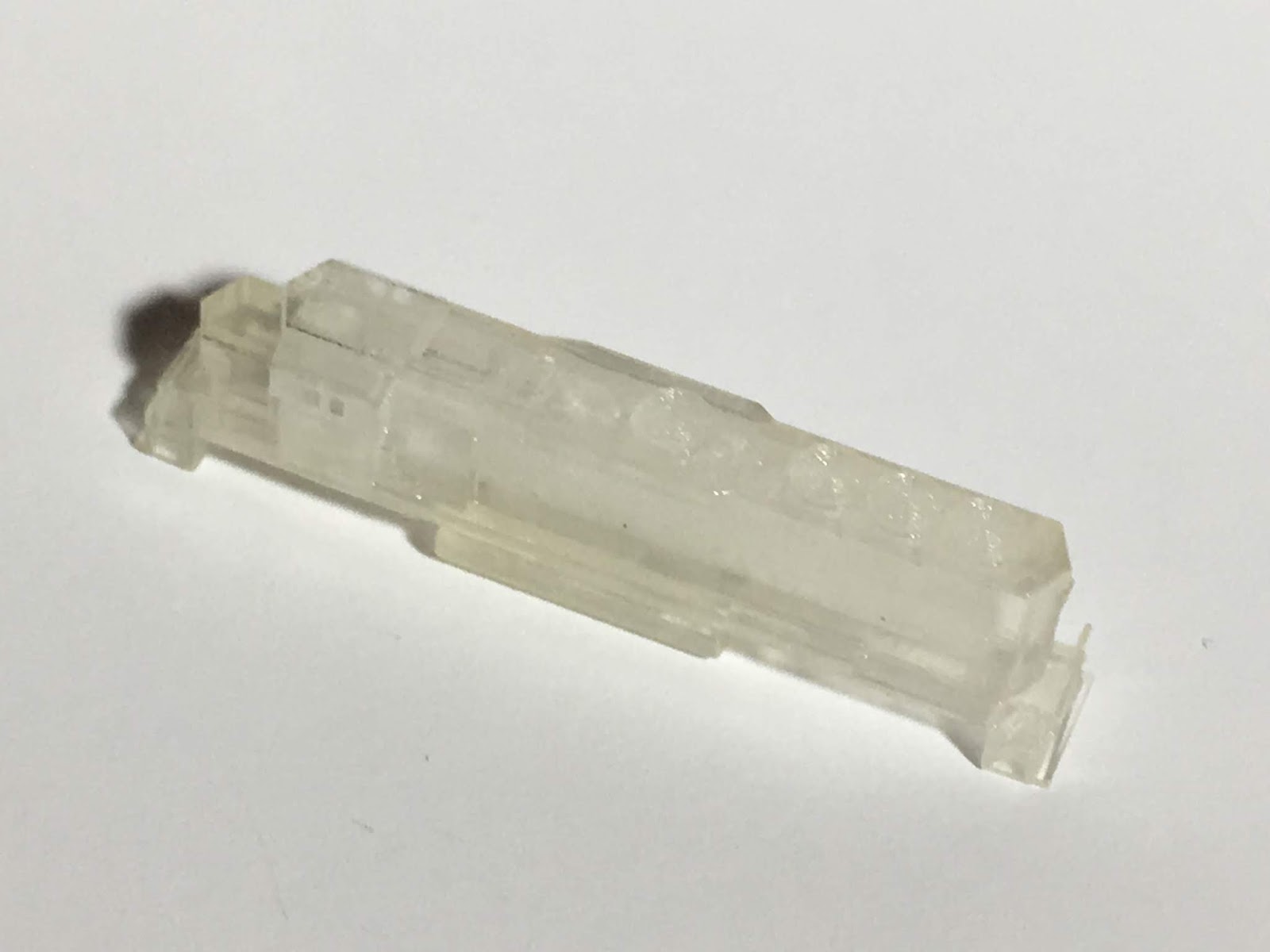

I drill a small (between 0.5 -1mm) hole or two in the underside of the model at this point for a couple reasons: First, it provides a point to secure a toothpick which is used as a handle for the shell during the finishing process.  Second, the holes serve as a mounting point for the small (3/16") neodymium magnets I use to create a positive downward "pull" by the model to the tracks.  If you are going to run these models--even as unpowered dummies as this model is-- they are so light they require added weight to stay on the track.  The magnets provide artificial "weight" to the model.

After some basic clean up and sanding, the shell gets a coat or two of brushed-on Future acrylic clear floor polish, then a spray on coat of Tamiya fine surface primer.  Imperfections are much easier to see after the primer.  I sand areas that are too rough lightly between coats.  I also try not to put on too much of either the Future or primer, because there's really some great detail that you don't want to obscure--fan detail, louvers, etc.  There will likely be some layering/lines visible from the printing process but until technology improves further, I find I can live with some minor imperfection--and the models look fine from normal viewing distance.  Here's what the shell looks like after primer applied and a little sanding:


Next we are on to main assembly, detailing, finish painting and decaling of the main shell.  But of course--I always do research on the prototype before this.  In fact, research is one of my favorite activities.  In this case I am modeling Chessie/B&O GP40-2 "GM50" which was a unique paint scheme to honor the 50th Anniversary of GM's ElectroMotive Division, the locomotive manufacturing arm of General Motors.  The internet has tons of reference material, just type in your subject in any search engine and you will likely get a ton of hits.  I found this picture as it shows a lot of details, the color scheme, and placement of lettering.

Notice this unit has dynamic brakes--evidenced by the bulge above the "Chessie" and extra roof fan.  The kit has the option to build the GP40-2 with dynamic brake or without.  You will want to add these on now if you didn't before, as well as any other major components such as the rock plow (although on this build I forgot until later).  I use regular ACC to attach such items.

On to the subject of lettering and decals:  There just are not many choices for decals in T-scale.  At my request, CMR Products has been great about reducing their line of decals by Netzlof Design to 1:450.  You can order them upon request (and you can even select 1:450 on the website now).  Even better, they are also working with me now to custom design some other new decals for Chessie and Conrail and N&W in 1:450 scale.

The GM50 wasn't one of these available at CMR--I designed and printed these myself on my trusty inkjet printer.  In fact, most dark color lettering can be adequately produced on store-bought clear decal film for inkjets.  Lighter colors/whites are basically impossible at this point as inkjets use the "white" of the paper or background, not a white ink.  Blacks/Blues/Greens are typically opaque enough.  The Chessie lettering is (technically) a very dark blue, but I use black because it really looks like black.  My design work and printing is done with PhotoScape software, but there are many options.  I just create a .jpg file--no need for ultra precision because these are reduced to such small size that it makes up for minor imperfections.  Here's the GM50 decal image file, which you can use if you like;  and technically there should be two of the 50th anniversary logos, one goes on the rear of the locomotive as well:

It takes some tweaking to get the size and printout quality correct--I print drafts on a sheet of plain white paper until I get the correct size, then do a "run" of 5-6 sets on the decal film paper (usually a single line across).   I trim off  the strip of decals then save the rest of the paper for another project.  I find there will be at least a few smudges or bad printing on each set--about a 75% ratio, so I always print extra sets.  Of great importance, after printing, the decals must be sealed before using--I use Krylon Crystal Clear acrylic coating (#1303).   Here's what they look like when printed and sealed.


Finally we are ready for finish painting.  The base color is Tamiya gold--it's actually a very simple scheme.  Here's the shell with it's gold paint applied two light coats.  It's starting to look solid!  (Pardon the pun..)

Once the finish coat is on you can apply the decals and it will start to look like it should!


It's coming together, but we still need to add couplers, trucks, and finishing details.

Since I forgot to add the Rock Plow pilot earlier, I trimmed off the footboards and added them now to the front and rear pilots.

Add the couplers.  CCE #3 couplers will pivot freely about 45 degrees left and right, but must be gently snapped free from a tiny pin inside the draft gear.  I did a short YouTube video showing how to do this.  Once working, slide the draft ear into the slot in the pilot.  They should fit snugly with just a press-fit.  I usually secure with a tiny bit of Future or MicroScale Krystal Klear.  This is because it's water soluble and if I ever need to remove the coupler it can be loosened and removed.  ACC wouldn't work because it would be stuck-tight!

Underneath the model, there are pilot holes for the trucks.  Drill these out with a .75-.80 mm bit--the trucks are designed to be secured with a 1mm screw.  I get my screws on Amazon and are sold in bulk for eyeglasses etc for a few dollars.  You can add the TGauge.com pin-point wheelsets before or after mounting the trucks.   I used the Blomberg "B" style trucks to suit the prototype.

I add the neodymium magnets at this point, and secure with a bit of Krystal Klear.  I have many uses for this water-soluble clear goop!  I hold them in place with a bit of tape until it dries.


Paint the trucks and couplers--gold for the trucks and I use Roof Brown for the couplers.  The final step is to add the miniscule horn.  I pre-painted it on the sprue and added it to a small hole in the cab roof.  I put to in the kit for a reason--I destroyed the first one.  As a finishing touch, I use Krytal Klear for small windows like the door and windshield, and use decal film for the cab side windows.  You can apply weathering at this point although this unit was special so please keep it light!


Thursday, January 10, 2019

Finishing Shapeways 3D Printed Plastic Models

Happy New Year to my T-Scale Friends!

I wanted to start off with a helpful "how to do it" post;  Over the years (since 2012) I have developed and refined a finishing technique for what was once Shapeways "FUD" (Frosted Ultra Detail) or currently "Smoothest Fine Detail Plastic" material.  It's not an absolute--you may tweak as per your own preferences of course--but I find it works well.

  1. Clean any oily/waxy residue off the shell.  For me, this is a three step process;  
    1. First, I use a solvent to clean it;  I use Vallejo Airbrush Thinner because it's readily available and I use for my airbrush, and it's not very noxious;  NOTE: Some modelers use Bestine and soak the model;  You might also try other acrylic or wax solvents.   
    2. After this, wash gently with a #6 brush or equivalent in warm soapy water, rinse, and allow to dry completely.  Inspect and repeat if necessary to remove any remaining waxy gunk.  
    3. Finally I use a stiffer brush to gently whisk the surface after this is done.  Be wary around any thin parts.  
    4. NOTE.  It's not absolutely necessary to do the solvent step, just warm water usually works fine and I did that for years.  The solvent cleans it just a little bit better.
  2. Sand any rough areas or printing striations lightly with fine sandpaper or sanding sticks.  Wash/rinse, let dry. 
  3. Apply 2 or 3 thin coats of Future acrylic floor wax (or other acrylic clear coat).   I apply with #2 brush and put it on thicker on any rough areas.  Inspect surface, sand and touch up again if  needed .  Remember the next layers of paint will also add thickness so try not to add too much .  For information on Future or it's equivalents:  http://www.swannysmodels.com/TheCompleteFuture.html
  4. Prime with spray primer of your choice.  I use Tamiya Fine Surface Primer rattle can.  Sand lightly again *if needed* and touch up.
    Primed, and a little extra sanding done.
  5. Apply finish coat(s);  I have successfully used both acrylic brush-on, and rattle can spray-can lacquer.  
    That looks better! I actually put a liiiiitle bit too much clear sealer on this one but it's ok.
  6. Decal and weather as needed/desired.
  7. NOTE:  Always allow coats to dry thoroughly before adding more, especially if different base (ie. lacquer vs acrylic).
  8. TIP:  Window glass can be represented with MicroScale Krystal Klear or using clear decal film.  I have used both successfully.
  9. TIP:  I drill a 1mm hole in the base of solid models, or put a small piece of foam in hollow ones, then insert a toothpick into the model as a temporary handle.  This can then be put into a hole poked in a "stand" or your choice--I often use an old Shapeways box!

Friday, December 21, 2018

Holiday Update from Jesse

I wanted to post an update on some projects and developments coming down the line, but first wanted to wish all of my fellow T-scale enthusiasts a Happy and Peaceful Holiday Season!  2018 saw a rekindling of my excitement in T-scale and 2019 will certainly be a big one judging from the amazing things coming out of other modelers' workshops.

I am continually seeking to develop new models, improve old ones..sometimes to the point of distraction.  However, sometimes a special request gets me motivated, or another modeler doing something.  Two cases in point:

I recently decided to make the EMD SW9/1200 EMD switcher since it's so common, and after successfully making it (and still making improvements) a Canadian modeler said "Boy it sure would be nice to have an SW1200RS.."   This is the GMD (Canadian) built and specially modified version of the SW1200.  It rides on Flexicoil trucks so those were put together.   Well it really didn't take too much to modify it, so I have added that to the product line.

Oh and notice--horns and bells (oh my).  Boy are they fragile, but they are there-- on mounting pins that can be drilled.  Also included are extra stacks if you want to model the CP version with the standard exhaust stacks.   The GP40 model also has horns and bells and in that case the bells are the underframe version).


The other motivation was the display of TGauge.com's big steam locomotive.  This was a big freight engine that hauled strings of boxcars across the plains of the US.  Years ago I developed a 40' boxcar, but it was fairly primitive.  So... I updated it, with better detail such a roofwalk and brake gear, and the neat new improvement is that the Bettendorf trucks have "talgo style" CCE #3 couplers built in.  This was motivated by the lack of space for the coupler separately when the improved truck design is used.  I needed the talgo/truck mount for other projects as well such as the 3-bay hopper.

A replica of the private car "Puget Sound" was recently completed, and it turned out quite nicely.  Those windows are clear "glass" made of decal film, but the dome is Krystal Klear.  This was originally a Great Northern Ry. Dome Coach so any GN or Amtrak modelers may want one.  I'll be adding it to the product line as soon as I can validate the truck design as it will also need the talgo trucks. 

In other news-- I'm testing some tiny 1/32-inch thick x 1/16 diameter round magnets from K&J Magnetics,  These are made of "N52" grade and are stronger than the regular ones.  These guys seem to work pretty well, and it takes 2-4 to hold a car reasonably in place on the track.  Necessary for the un-powered models especially.

Thanks for reading, and Happy T-Scale Modeling!

Monday, December 3, 2018

How To Video: TGauge.com Needle Point Wheelset Assembly

I use TGauge.com "Pin Point Wheelsets" for my free rolling trucks (bogies).  When I first purchased them I wanted to save a little by getting the un-assembled set of 20.   After a lesson in frustration trying to assemble them with tweezers and pliers and bare fingers, and sending a couple flying into the void, I devised a way to assemble with a pin-vice and some tacky foam strip.  Here's a video illustrating the procedure:


Friday, November 30, 2018

Project Updates

Since the last post I've made quite a bit of progress on several fronts.  Here are the details:

Turnout prototype:  The #10 dummy turnout (it's permanently lined in one direction) was a qualified success.  I have additional slightly revised models on the way from Shapeways, and included detail such as an switch machine and hand-throw switchstand with lantern like the B&O used.  It looks great, and rolling stock makes it through without issue.  It's designed to be compatible with the roadbed strips (also improved to be stronger).  If you want turnouts, a set of two is available on Shapeways, and so are the roadbed strips.
  I'm almost ready to start laying track on a test module!

Trucks:  I modified the trucks (starting with the AAR switcher trucks used on the SW7, and have since updated the Blombergs, see photo.  This includes improving the robustness of them to not break so easily, and to retain the wheelsets better.  I'm satisfied, and will be rolling out across all the trucks as is feasible, and adding to kits with the shells.  The GP40 is out there with the new trucks.  The only issue is this new design is that it's tough to incorporate on smaller trucks like the roller bearing trucks;  I came up with an alternative I'm testing now and will post as I get prototypes back.

SW9/SW1200:  The dummy SW9 is out there (it's visually identical to the SW1200, hence the slash) in the shop now, in a kit which includes the new AAR switcher trucks and a horn and bell.. I'm not sure they'll print successfully but you can't say I'm not trying to push the limits :-)  I painted one up in Conrail paint as SW9 #9000 using some scavenged N-scale decals.  The number was from freight car data, cut down to size.   All in all I'm quite happy with this model!  I'm anticipating getting a powered boxcar, and have a short train of SW9/box/box/caboose..


Speaking of cabooses.. I'm in the process of revising the NE Caboose to include better detail, truck and couplers.  (Same applies to much of the lineup..) Plenty of work to do until next time! 

Wednesday, November 14, 2018

"T" easers and Pleasers

It seems like I have too many projects going on, but progress is being made.  There's just so much testing and re-testing that needs to be done until I'm satisfied (I'm probably one of Shapeways' best customers...) but the pace should settle down once I have the basics covered.

Trucks are on the list.  I need trucks that are substantial enough to take some abuse, hold the wheelsets, and still look reasonably good.  I have the latest batch of test trucks on the way.  There's a suspension that holds the axle in place a bit better and is actually sprung.  I call this the Union Jack suspension since it has several cross-shaped support structures.   I have Blomberg B's, some AAR switcher trucks, and internal bearing test subjects coming.  These are in 2nd or 3rd generation at this point and getting better with each try.

I also am trying horns (and bells) again.  Cross your fingers.  I made some jewelry recently that shows the process (lost wax) is capable with the dimensions I  need, but previously SW declined to try.  Maybe they will print them now??

Oh and this experiment is also on the way (inspired by a post on Facebook..).  It's a dummy but, it's a step towards something functional.  It should work for a fixed line turnout anyway with Code 40 rail, which would be fine for my non-switching layout (the way I figure it, functional turnouts can be located behind the scenes for changing the line of trains).   If it works, I could make straight or diverging versions..

I also made a section of tie strip with roadbed.. the ties are really very fragile, so the roadbed should help make them more rugged and it's designed for a ballast coating to make it look realistic.

As if all this wasn't enough, I'm still refining the GG1, I did an SW9/1200 (SW7/8 if you chop a stack off), and refined the GP40.

Stay tuned, I'm shifting into more of a modelling mode (less computer design) to do some work on a dome car project/small display.  I can't afford all the Shapeways orders anyway!

--Jesse

Thursday, November 8, 2018

Next Up: Trucks

aka Bogies..

The needlepoint wheelsets fit into the new trucks, but they aren't all that solid.  If you put much presure on them, they'll slip--the sideframes are just too thin and flex a little bit.  So, still not perfect.

Some time ago, I made some prototype "internal bearing" passenger trucks to fit on the Amfleet coach which incorporated a "snap fit" for the axle between the wheels.  Test #1 was too small and snapped, not quite rugged enough either.   I then got distracted with other projects and tabled it. 

Recently, I was putting wheelsets into a set of Blombergs and I having a heckuvatime keeping the wheelsets in.  This isn't acceptable-- there must be a better way.  So I combined the idea of the internal bearing truck with a tab that holds the wheelset in place.  Prototypes are on the way..  It only takes a few iterations to get it right, aka persistence pays off as shows with the coupler.