A prototype of a new automatic version of the CCE knuckle coupler is on the way... if it (or subsequent iterations) actually work, it would allow automatic coupling and uncoupling with a hand-held tool. It uses magnets to achieve the automation. We shall see, but I think it has promise.
One of the downsides to this is I will need to update virtually every "kit" model I've made (which include couplers.) I needed to do this anyway due to need for many kits to have the new roller bearing trucks added, and the updated detail on the couplers.. but wow. I'm thinking maybe I should leave trucks and couplers off the models and just sell them separately unless they are highly specialized trucks. I have standardized on a 1mm bolster pin for the trucks.
I revised and updated a model I never actually sold in the store..an 89' flatcar commonly used for trailer train service. It could also be the basis for an autorack car and others.
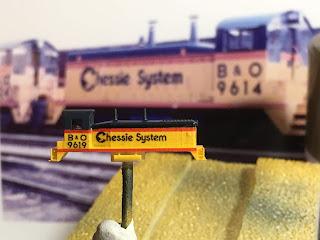
A model of the Sharonville (Ohio) engine house, built by the New York Central and operated up into the Conrail era is on the way. Most of it is 3D printed, but the roof will just be sheet styrene. I'm planning to do a small diorama of the engine facility there to display models.
Monday, September 23, 2019

Friday, September 20, 2019
New Developments and Buying CCE Models
It's been a busy month or so and I apologize for not updating the blog more often! There are several new developments with my T scale modeling and how CCE Models are offered for sale.
Improved (v.2) CCE knuckle coupler. The v.2 coupler has been enhanced to offer an articulated clasping movement, so although not automatic, it is more workable. Gently rotating the models to either side works to uncouple, and you can usually push gently together to couple. I'm still tinkering with ways to automate this or at least allow automatic coupling. One idea uses a very tiny metal "air hose" but that I forsee will just create more issues with catching in trackwork, etc.
The coupler also has improved detail, so it looks more accurate. And on a related matter, since I do a lot of talgo-style trucks with couplers: I improved the look of the roller bearing trucks to have a more realistic profile and springs.

50' Plate F Boxcars: At the request of a Facebook T Scale group member (Michael Doll), I designed a pair of modern Plate "F" (hi cube) 50-foot boxcars. One is a Greenbriar prototype and the other National Steel Car; The main difference is the NSC version has horizontal outside ribs as well as the vertical ones. These are pretty common today, and should fit onto one of the powered mechanisms if you want to add power to your trains.
PRR Signal Gantry: After the initial proof of concept, I have refined the etched brass PRR signal bridge to have accurate bents and improved detail such as cross-bracing on the bridge. This will be available in 5- and 4-track variants; I may do a 2-track but I think it could be kitbashed to a 2-track without much trouble.
As of September 2019, I no longer drop-ship through Shapeways. I will still manufacture with Shapeways for the time being, but will ship from my stock.
There are a couple reasons for this. Mainly, it is because I push the limits of Shapeways design parameters, so every time I add (or change) a model I have to fight them to print it. I always must use a feature called "Print it anyway" which puts the risk of a failed print on me. Although my designs have been 100% successful when I have used this feature, Sheapeways still doesn't allow customers to order this way. The result is that about half the time when someone tries to order a CCE kit, Shapeways cancels it because of "thin walls" or "thin wires" in the design.
It's really frustrating and they have not been willing to do anything about it, I have decided to just sell and ship directly. This allows me the additional ability to inspect models and ensure they are perfect before I ship. I am also including additional details, such as etched brass handrails on certain models. I'd like to get some more professional looking packaging as well.
Here is the CCE Models Product List
It's just a rudimentary list for now, but I will be enhancing it with descriptions, pictures, etc. shortly.
To order, emai your request to CCEModels@gmail.com. I will confirm your order, manufacture and ship to you via Priority Mail. Payment (prior to shipping) may be made via PayPal. Shipping & Handling charge is a flat $8.00 for up to 4 kits (in USA). I will quote shipping on anything larger or international. If you have any other requests, such as custom build/paint, or a custom design, just let me know.
Jesse/CCE Models
Changes to CCE Knuckle Coupler and Roller Bearing Trucks:
Improved (v.2) CCE knuckle coupler. The v.2 coupler has been enhanced to offer an articulated clasping movement, so although not automatic, it is more workable. Gently rotating the models to either side works to uncouple, and you can usually push gently together to couple. I'm still tinkering with ways to automate this or at least allow automatic coupling. One idea uses a very tiny metal "air hose" but that I forsee will just create more issues with catching in trackwork, etc.
The coupler also has improved detail, so it looks more accurate. And on a related matter, since I do a lot of talgo-style trucks with couplers: I improved the look of the roller bearing trucks to have a more realistic profile and springs.

New Models:
50' Plate F Boxcars: At the request of a Facebook T Scale group member (Michael Doll), I designed a pair of modern Plate "F" (hi cube) 50-foot boxcars. One is a Greenbriar prototype and the other National Steel Car; The main difference is the NSC version has horizontal outside ribs as well as the vertical ones. These are pretty common today, and should fit onto one of the powered mechanisms if you want to add power to your trains.
PRR Signal Gantry: After the initial proof of concept, I have refined the etched brass PRR signal bridge to have accurate bents and improved detail such as cross-bracing on the bridge. This will be available in 5- and 4-track variants; I may do a 2-track but I think it could be kitbashed to a 2-track without much trouble.
How to Purchase CCE Models:
As of September 2019, I no longer drop-ship through Shapeways. I will still manufacture with Shapeways for the time being, but will ship from my stock.
There are a couple reasons for this. Mainly, it is because I push the limits of Shapeways design parameters, so every time I add (or change) a model I have to fight them to print it. I always must use a feature called "Print it anyway" which puts the risk of a failed print on me. Although my designs have been 100% successful when I have used this feature, Sheapeways still doesn't allow customers to order this way. The result is that about half the time when someone tries to order a CCE kit, Shapeways cancels it because of "thin walls" or "thin wires" in the design.
It's really frustrating and they have not been willing to do anything about it, I have decided to just sell and ship directly. This allows me the additional ability to inspect models and ensure they are perfect before I ship. I am also including additional details, such as etched brass handrails on certain models. I'd like to get some more professional looking packaging as well.
Here is the CCE Models Product List
It's just a rudimentary list for now, but I will be enhancing it with descriptions, pictures, etc. shortly.
To order, emai your request to CCEModels@gmail.com. I will confirm your order, manufacture and ship to you via Priority Mail. Payment (prior to shipping) may be made via PayPal. Shipping & Handling charge is a flat $8.00 for up to 4 kits (in USA). I will quote shipping on anything larger or international. If you have any other requests, such as custom build/paint, or a custom design, just let me know.
Jesse/CCE Models
Thursday, August 15, 2019
New Products.
I wanted to share some updates.
Latest new models:
--GP38/39/-2, with etched handrails. This model can be built with or without dynamic brakes. I made the decals myself, printed on an inkjet.

-- 2-bay and 4-bay Covered Hoppers. The 4 bay covered hopper can be built with either grain hatches (long rectangular ones) or round hatches on top. The 2-bay hopper pictured here features decals from CMR Products.

-- I couldn't remember if I posted pictures of the FP7 model, but here's one I did in Conrail patch paint job. This kit allows you to build with several different variations of fuel tank skirt and nose details. These are also CMR/Netzlof Design decals.

-- I saved the best rolling stock for last. The GE U25B. This features AAR-B type trucks, and etched brass handrails. The decals are from CMR Products (and can be used on most Conrail diesels.) Also notice the little searchlight signal I threw together on a whim. I made this out of a piece of .03 nickle silver rod and a target from one of the etched crossing signals. The hood is .05 tube cut in half. The target is actually quite small--should be 2.5-3mm, however would be prototypic for a few applications like on the NYC.

Some other things I have cooked up in preparation for the Princeton Jct. module are etched brass catenary and PRR style signal gantry. The side braces for the signal gantry need to be corrected but the catenary looks decent. That is 0.5mm styrene square rod for the poles.

Saturday, June 15, 2019
The Case for T Scale
Today's post is more of an editorial comment than anything else. Below are some of my thoughts on the advantages of T scale versus other model railroad scales. Essentially, it's a summary of why I like modeling in 1:450, along with some thoughts on where it will go from here. If you would like to reply and comment, please do so! I'd like to hear from others who visit my Blog. - Jesse
Years ago, I picked up a copy of the charter "N Scale" magazine published by Bob Hundman (July/Aug 1989). In it there was an editorial titled "The Case for N Scale" which outlined why N scale could be a great modeler's scale-- this was in the years before there were a multitude of highly detailed RTR models, good track, electronics, structure kits, etc. available; Kadee's "MicroTrains Line" was a leader, and Atlas has a decent array of rolling stock. Kato was pretty new to the scene. Track was pretty terrible (Atlas flex), but Micro Engineering had some great flex track. A lot of scratch building was still necessary, and detailing was nowhere near the level of today. DCC was in it's infancy. But you could tell N scale had potential, from the brilliance of Pete Thomas' module to the beautiful brass Shay on the back cover. I think T scale has that same potential. Here are my main reasons why I find T scale (1:450) a great choice for scale model railroading:
1. You can model scenery to scale.
Because T scale is so small, it makes faithfully scaled-down scenes possible in a reasonable amount of space. For this reason, 1:450 is a popular scale for architects, civil engineers, and ship modelers. At the very least, much less "selective compression" is needed to capture a scene like the prototype. Curves can be made much broader, turnouts longer, spaces more wide open.. I'm currently planning a small diorama/module of Princeton Jct., which faithfully represents the station, full ex-PRR 4-track mainline, and a bit of the Princeton branch, in only 8x30 .. inches. I will probably shorten the platform a bit and move a highway overpass to cut off the scene but this is still a highly accurate representation of the area.
2. It makes modeling possible in small spaces.
Many of us don't have large basements, garages, or even spare rooms to semi-permanently convert to train rooms. Or, if we did we might not want to dedicate so much space to hobby use. T scale can be modeled in the smallest of apartments, layouts carried in and out doors without hassle, niches found that can harbor models without much ado. I do all my modeling in a corner of my kitchen in my apartment. All my models fit on a quarter of a single shelf in a china cabinet. Granted, it's only about 10 pieces of rolling stock, a couple structures and some dioramas but try that in HO or O.. T scale is extremely space efficient!
3. It's a low cost scale.
T scale is actually relatively cheap to model in. First, because of the size of the models, any supplies go a very long way. One Dullcote rattle lasts for scores of models. Paints, cements, landscaping materials, scratchbuilding supplies... all last a very long time. One small bag of ballast can do miles of track! Yes the mechanisms and components can be comparable to other scales (ie. $40 for a locomotive mechanism) but the rest is highly cheap. And because there is so much scratch building that also minimizes the "expensive RTR model" issue.
4. It's a modeler's scale.
There is basically a tiny smattering of RTR models available in T, most are European and Japanese prototype and the lone US model (a "GP8") is an overscale, clumsy representation of the prototype. (I'll never know why they picked the remanufactured GP8... why not just a GP7 or GP9?) In any case, in order to have accurate North American models I have had to design and build them basically from scratch. I employ 3D printing however I have seen other nice models made from styrene and brass bits. I recently built a Santa Fe semaphore signal-- 0.3 brass wire, a modified bit of an etched crossing gate and a bit of 1mm styreme rod. In other scales, there's a tendency to just buy off the shelf, ready to run models and scenic accessories.. because you can! In T, there isn't anything like that so if you want them, you just have to make them. I discovered this process is fundamentally rewarding. That U25B or GG1... I didn't just assemble it, I literally created it from 3D blueprints and brought it to reality. That process is part of the fun that I think many modelers in other scales miss out on. You also need to hone your painting and drafting skills because there are very few decals (there weren't any until I convinced CMR Products to make T scale decals of their designs to order).. so complex paint schemes must be masked and/or hand painted.
5. It broadens your modeling horizons.
Because there are so few T scale modelers in the world, the community is by necessity compressed and comprised of modelers from all corners of the globe. Consequently, there is a very interesting and beneficial cross-pollination among modelers. I've interacted with T scalers in the UK, Germany, Japan, China, India, Australia, New Zealand, and the USA. The Orbost module is a landmark, Doug Kightly's amazing "Bridge", and Ewe Fenk's fantastic hand-built locomotives all have provided inspiration. David K. Smith's models were the inspiration for my early attempts at US prototypes in T. And since then, I've built models of the British Railways' Deltic, Class 67, Class 66, and the Victorian Railways "S" class diesels. I built models of the RhB ABe 4/4 iii and learned about the Bernia Loop in the process. I was generally unaware of these fantastic railroads and locomotives until I delved into T scale.
6. The Coolness factor.
Ok, I'll admit it. I like being able to say "I make the smallest model trains in the world." Or seeing eyes pop when they see how tiny these models really are. We T scalers are definitely part of a select few. In a sense, we're the odd bunch, the modeling purists, the tinkerers and engineers who will find a way to do things just to see if we can in 1:450 scale.
Post Script:
Harsh reality must be faced. It is not a great operating scale. I rarely even run models at all because they just don't given the light weight and track issues. Rolling stock must still be used to push unpowered locomotives due to space limitations in the loco shells. True, pulse transformers have helped, and have made for reasonable running at scale speeds but commercial track is still quite oversize, clumsily rendered, and oxidizes easily. Tie size and spacing is altogether wrong for North America, and the commercial turnouts are terrible. The coupling system is similarly awful, being oversize, not prototypic at all, and not automatic (my 3D printed ones are better but are dummy couplers). The electric motor and drive mechanism are just a bit too large to work in hood diesels.
Frankly, T scale is nowhere near where N scale was in 1989 right now.. It may be closer to N scale in 1969.. My wish list is for the next 5 years is to get a manufacturer to take the plunge and make those above components and perhaps even some North American rolling stock models (although 3D printing is making rapid enough advances that rolling stock isn't such an issue for me.) Those "infrastructure" components are the real issue if T is to gain popularity as a scale. What a world of difference good American flex track, working #8 and #10 turnouts, and a working semi-scale knuckle coupler would be..! Add an economical 2mm diameter 4v motor (or complete canned drive mechanism less that 3mm thick) that could be worked into the shells of hood diesels..
Well, back to the drawing board!
Years ago, I picked up a copy of the charter "N Scale" magazine published by Bob Hundman (July/Aug 1989). In it there was an editorial titled "The Case for N Scale" which outlined why N scale could be a great modeler's scale-- this was in the years before there were a multitude of highly detailed RTR models, good track, electronics, structure kits, etc. available; Kadee's "MicroTrains Line" was a leader, and Atlas has a decent array of rolling stock. Kato was pretty new to the scene. Track was pretty terrible (Atlas flex), but Micro Engineering had some great flex track. A lot of scratch building was still necessary, and detailing was nowhere near the level of today. DCC was in it's infancy. But you could tell N scale had potential, from the brilliance of Pete Thomas' module to the beautiful brass Shay on the back cover. I think T scale has that same potential. Here are my main reasons why I find T scale (1:450) a great choice for scale model railroading:
1. You can model scenery to scale.
Because T scale is so small, it makes faithfully scaled-down scenes possible in a reasonable amount of space. For this reason, 1:450 is a popular scale for architects, civil engineers, and ship modelers. At the very least, much less "selective compression" is needed to capture a scene like the prototype. Curves can be made much broader, turnouts longer, spaces more wide open.. I'm currently planning a small diorama/module of Princeton Jct., which faithfully represents the station, full ex-PRR 4-track mainline, and a bit of the Princeton branch, in only 8x30 .. inches. I will probably shorten the platform a bit and move a highway overpass to cut off the scene but this is still a highly accurate representation of the area.
2. It makes modeling possible in small spaces.
Many of us don't have large basements, garages, or even spare rooms to semi-permanently convert to train rooms. Or, if we did we might not want to dedicate so much space to hobby use. T scale can be modeled in the smallest of apartments, layouts carried in and out doors without hassle, niches found that can harbor models without much ado. I do all my modeling in a corner of my kitchen in my apartment. All my models fit on a quarter of a single shelf in a china cabinet. Granted, it's only about 10 pieces of rolling stock, a couple structures and some dioramas but try that in HO or O.. T scale is extremely space efficient!
3. It's a low cost scale.
T scale is actually relatively cheap to model in. First, because of the size of the models, any supplies go a very long way. One Dullcote rattle lasts for scores of models. Paints, cements, landscaping materials, scratchbuilding supplies... all last a very long time. One small bag of ballast can do miles of track! Yes the mechanisms and components can be comparable to other scales (ie. $40 for a locomotive mechanism) but the rest is highly cheap. And because there is so much scratch building that also minimizes the "expensive RTR model" issue.
4. It's a modeler's scale.
There is basically a tiny smattering of RTR models available in T, most are European and Japanese prototype and the lone US model (a "GP8") is an overscale, clumsy representation of the prototype. (I'll never know why they picked the remanufactured GP8... why not just a GP7 or GP9?) In any case, in order to have accurate North American models I have had to design and build them basically from scratch. I employ 3D printing however I have seen other nice models made from styrene and brass bits. I recently built a Santa Fe semaphore signal-- 0.3 brass wire, a modified bit of an etched crossing gate and a bit of 1mm styreme rod. In other scales, there's a tendency to just buy off the shelf, ready to run models and scenic accessories.. because you can! In T, there isn't anything like that so if you want them, you just have to make them. I discovered this process is fundamentally rewarding. That U25B or GG1... I didn't just assemble it, I literally created it from 3D blueprints and brought it to reality. That process is part of the fun that I think many modelers in other scales miss out on. You also need to hone your painting and drafting skills because there are very few decals (there weren't any until I convinced CMR Products to make T scale decals of their designs to order).. so complex paint schemes must be masked and/or hand painted.
5. It broadens your modeling horizons.
Because there are so few T scale modelers in the world, the community is by necessity compressed and comprised of modelers from all corners of the globe. Consequently, there is a very interesting and beneficial cross-pollination among modelers. I've interacted with T scalers in the UK, Germany, Japan, China, India, Australia, New Zealand, and the USA. The Orbost module is a landmark, Doug Kightly's amazing "Bridge", and Ewe Fenk's fantastic hand-built locomotives all have provided inspiration. David K. Smith's models were the inspiration for my early attempts at US prototypes in T. And since then, I've built models of the British Railways' Deltic, Class 67, Class 66, and the Victorian Railways "S" class diesels. I built models of the RhB ABe 4/4 iii and learned about the Bernia Loop in the process. I was generally unaware of these fantastic railroads and locomotives until I delved into T scale.
6. The Coolness factor.
Ok, I'll admit it. I like being able to say "I make the smallest model trains in the world." Or seeing eyes pop when they see how tiny these models really are. We T scalers are definitely part of a select few. In a sense, we're the odd bunch, the modeling purists, the tinkerers and engineers who will find a way to do things just to see if we can in 1:450 scale.
Post Script:
Harsh reality must be faced. It is not a great operating scale. I rarely even run models at all because they just don't given the light weight and track issues. Rolling stock must still be used to push unpowered locomotives due to space limitations in the loco shells. True, pulse transformers have helped, and have made for reasonable running at scale speeds but commercial track is still quite oversize, clumsily rendered, and oxidizes easily. Tie size and spacing is altogether wrong for North America, and the commercial turnouts are terrible. The coupling system is similarly awful, being oversize, not prototypic at all, and not automatic (my 3D printed ones are better but are dummy couplers). The electric motor and drive mechanism are just a bit too large to work in hood diesels.
Frankly, T scale is nowhere near where N scale was in 1989 right now.. It may be closer to N scale in 1969.. My wish list is for the next 5 years is to get a manufacturer to take the plunge and make those above components and perhaps even some North American rolling stock models (although 3D printing is making rapid enough advances that rolling stock isn't such an issue for me.) Those "infrastructure" components are the real issue if T is to gain popularity as a scale. What a world of difference good American flex track, working #8 and #10 turnouts, and a working semi-scale knuckle coupler would be..! Add an economical 2mm diameter 4v motor (or complete canned drive mechanism less that 3mm thick) that could be worked into the shells of hood diesels..
Well, back to the drawing board!
Saturday, June 1, 2019
Recent Projects
I've been working a lot on finishing up some prototype models including an FP7A, GG1, and F7A. Probably the most exciting is the GG1, which is designed to accept a custom drive mechanism designed by fellow T-scaler Joe Malinchak (Joe has also done some amazing steam engines in T-scale). My version is a static model,but could be switched at some point; I mainly just wanted to work out how the etched details (pantograph) worked and if I could do a respectable Amtrak paint scheme.
 The FP7 is sitting in the background; Neither model has been weathered yet. I also designed the catenary for a PRR installation as well as a PRR signal bridge and CPL signal heads... another project on the schedule.
Currently I'm painting up a true "classic", the ATSF "Warbonnet" passenger paint scheme on an F7A. The F-unit was an old design I recently updated, and it's actually been updated since with louvers. This was mainly a challenge on the decorating side because the warbonnet scheme is pretty complicated and light colors like yellow (or even a good solid red) can't be done on any color other than white. So I masked all the colors, even the thin yellow and red striping. The lettering and black pinstripes are inkjet decals. I'll post pics when I finish it up.


Currently I'm painting up a true "classic", the ATSF "Warbonnet" passenger paint scheme on an F7A. The F-unit was an old design I recently updated, and it's actually been updated since with louvers. This was mainly a challenge on the decorating side because the warbonnet scheme is pretty complicated and light colors like yellow (or even a good solid red) can't be done on any color other than white. So I masked all the colors, even the thin yellow and red striping. The lettering and black pinstripes are inkjet decals. I'll post pics when I finish it up.

Thursday, April 4, 2019
Etching Successes and Plans
Recently I noted I was going to have some detail items etched, and after receiving them (in a very short turn around from PPD Ltd in the UK) I think it was a success.. here are the crossbucks and handrails on the SW1200):

 SO now, as the GG1 takes shape (literally) there are a host of accessories
and additional scenery items needed if the big electric motor's going to reside in a
prototypical world on a layout or diorama.
SO now, as the GG1 takes shape (literally) there are a host of accessories
and additional scenery items needed if the big electric motor's going to reside in a
prototypical world on a layout or diorama.
First of all, the prominent pantographs are needed... Altough Eishindo makes some respectable tiny panto's, they are just too small for the GG1 motor. I've designed some pantographs that are a one-piece etching to be folded into the diamond shape. The upper portions of the G' had to be modified as well to accept the pantographs.
In addition there is catenary, and signalling.. The trolley wire is one thing..not sure I'm going to even try the wires.. but the poles and supports are needed. They'd need to be somewhat sturdy, and I don't think Shapeways' FXD plastic is up to the job on that. There would certainly be warping as well with long, thin parts. Styrene or brass would be better; I found some 1mm square styrene rod online, and that will serve as the poles. The crossarms will be etched parts with insulators included. Insulators will get a healthy coating of paint to give them depth.
There are also PRR signal gantries; These will also use the 1mm rod for the main cross braces, but they will be sandwiched by etched lattices with tabs for mounting PRR CPL signal heads. These will be 3D printed in the variety of styles needed. Here's a rendering of the under-wire signal mast.
 So several projects are converging, and some interesting modeling is ahead!


First of all, the prominent pantographs are needed... Altough Eishindo makes some respectable tiny panto's, they are just too small for the GG1 motor. I've designed some pantographs that are a one-piece etching to be folded into the diamond shape. The upper portions of the G' had to be modified as well to accept the pantographs.
In addition there is catenary, and signalling.. The trolley wire is one thing..not sure I'm going to even try the wires.. but the poles and supports are needed. They'd need to be somewhat sturdy, and I don't think Shapeways' FXD plastic is up to the job on that. There would certainly be warping as well with long, thin parts. Styrene or brass would be better; I found some 1mm square styrene rod online, and that will serve as the poles. The crossarms will be etched parts with insulators included. Insulators will get a healthy coating of paint to give them depth.
There are also PRR signal gantries; These will also use the 1mm rod for the main cross braces, but they will be sandwiched by etched lattices with tabs for mounting PRR CPL signal heads. These will be 3D printed in the variety of styles needed. Here's a rendering of the under-wire signal mast.

Thursday, March 7, 2019
The Latest Projects aka the Back Shop
Here's a quick summary of recent developments and projects.
1. Handrails for the GP40, GP38 (new), and SW9/SW1200 in etched stainless steel.
2. Crossbucks, with and without warning flashers, gate arm, and with a cantilevered flasher in etched stainless.
3. New GP38/GP39 model at Shapeways
4. New ACF 2700 cu ft 2-bay hopper at Shapeways
5. Improved 40' boxcar
6. Improved 60' boxcar
7. Modified GP40 so it can be built with or without dynamic brakes.
8. Continued work on the GG1, which will have a powering kit available that is being developed with another modeler
9. Testing a design for a thinner drive mechanism that will fit in the GP40
10. Custom run of Netzlof design decals for a variety of roads is being done.
11. AAR type "B" trucks completed, now working on a U25B shell.
Some pictures:


1. Handrails for the GP40, GP38 (new), and SW9/SW1200 in etched stainless steel.
2. Crossbucks, with and without warning flashers, gate arm, and with a cantilevered flasher in etched stainless.
3. New GP38/GP39 model at Shapeways
4. New ACF 2700 cu ft 2-bay hopper at Shapeways
5. Improved 40' boxcar
6. Improved 60' boxcar
7. Modified GP40 so it can be built with or without dynamic brakes.
8. Continued work on the GG1, which will have a powering kit available that is being developed with another modeler
9. Testing a design for a thinner drive mechanism that will fit in the GP40
10. Custom run of Netzlof design decals for a variety of roads is being done.
11. AAR type "B" trucks completed, now working on a U25B shell.
Some pictures:


Subscribe to:
Posts (Atom)