I had mentioned the fine Netzlof Design decals sold by CMR Products in a previous post and wanted to share another project utilizing their decals.
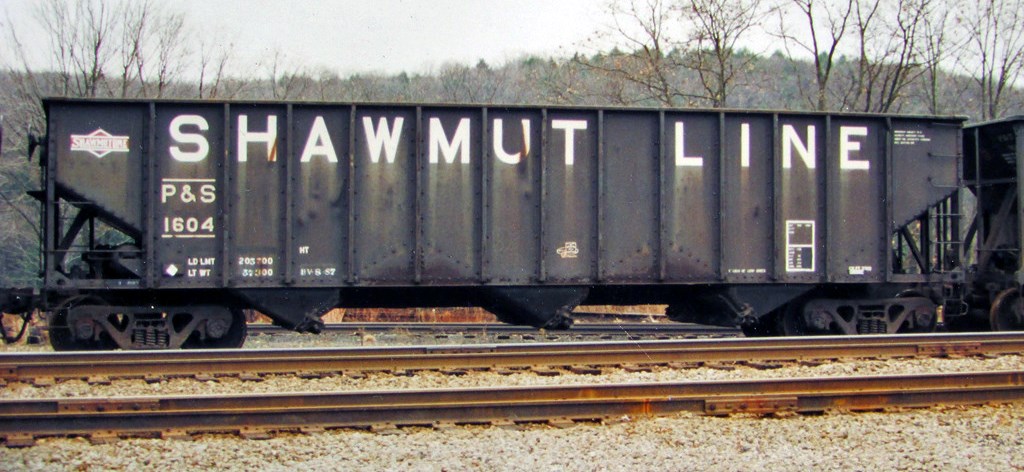
Some time ago I made a 3-bay hopper, which I recently revised to add more detail, and the results are attached. The new hopper body is in the store. Now, I still need the roller bearing trucks (still working on them..) Oh and some COTS decals!
Here's the prototype:
And the 1:450 scale model:
News and information about my model railroading and the designs made by CCE Models.
Saturday, September 22, 2018
Friday, September 21, 2018
T Scale Track Proof of Concept
Seems like I have a million and one T-scale projects going on.. one of them is to come up with a better representation of North American track (mainly crosstie size and spacing) using the smallest (Code 40) magnetic rail available.
As a proof of concept, I made up some "flex track" ties and got a test print back; More improvements needed but, the difference is, to my eyes, fantastic! I'm pretty fired up--stay tuned as I refine this model.
Tuesday, September 18, 2018
Princeton Jct. in T-Scale Concept
When I was a teenager, I accompanied my sister and mother on a trip east to look at colleges. One stop was at Princeton. I requested to be dropped off at the Princeton Jct. station on the Northeast Corridor and spent a great afternoon watching and photographing E60's, GG1's, Conrail and SEPTA trains.
Fast-forward 40 years and I am thinking about an idea for a T-scale layout/diorama of the Princeton Jct. station that would allow for a 4-track mainline under catenary, with Conrail diesels and Amtrak trains.
Which got me thinking of developing a few models in T-scale to use on such a layout. I have 3 prototypes in the works that would fit nicely. They all still need refinement but I am making progress.
One of the other benefits is I am developing an internal bearing bogie which can also be used on the bi-level coaches. Still, lots of work to do but I'm very productive lately. The biggest snag is the cycle time to get prototypes from Shapeways. Speaking of which, several models previously mentioned are on the way and/or being revised.
Fast-forward 40 years and I am thinking about an idea for a T-scale layout/diorama of the Princeton Jct. station that would allow for a 4-track mainline under catenary, with Conrail diesels and Amtrak trains.
Which got me thinking of developing a few models in T-scale to use on such a layout. I have 3 prototypes in the works that would fit nicely. They all still need refinement but I am making progress.
One of the other benefits is I am developing an internal bearing bogie which can also be used on the bi-level coaches. Still, lots of work to do but I'm very productive lately. The biggest snag is the cycle time to get prototypes from Shapeways. Speaking of which, several models previously mentioned are on the way and/or being revised.
Tuesday, September 11, 2018
A Couple of Developments
One of my sources of "prototype futzing" with T-scale has been the couplers. The stock couplers, with their square/angular oversize appearance, just don't look much at all like real couplers--at least those found in North America (or some other parts of the world, Australia, South America, etc.). They might have some redeeming quality if they actually were operational, but they aren't (although the good people at T-Gauge.Com are developing a T-scale coupler that has some automatic coupling capability!). I don't forsee T scale being much of a switching scale for the time being, but I do want more prototypic rolling stock for the "roundy-round" style I want, so I set about trying to make a better coupler, more resembling the standard knuckle coupler found in the US.
First, I scaled down a typical prototype coupler in the US (the Janney Coupler) and printed in what materials I could on Shapeways. At the time this was only the old "Frosted Detail"; but the results not only were these just too small, but far, far too fragile. So I scaled them up and printed them in bronze. This was semi-successful. The fit was so tight I needed pliers to get them apart, and the cost was outrageous (somewhere around $15 for a set of 4). There were no other alternative materials, and so the project was set aside.
Fast forward a few years, my interest in T-scale rekindled.. and some additional material options available on Shapeways. I tried the "Professional Plastic" and it seemed to have promise. After a couple tweaks to the design I printed what you see below. They come on a small sprue and printed in a gray material, so I painted a rust-brown color.
Note they are holding together unaided. It is a decently firm grip--but not so tight you can't separate them. The material is grainy in texture, but paint seems to fill in the texture, even looking a bit like cast iron. They are somewhat flexible and are remarkably strong and resilient. I found I had to sand/trim them a bit to fit through the pilot hole in the GP40, reducing the horizontal profile a bit.
Yes they are still over-sized but they are small enough and prototypic-looking enough for me to be "good enough". I will be striving to make them smaller and see how small I can get.
First, I scaled down a typical prototype coupler in the US (the Janney Coupler) and printed in what materials I could on Shapeways. At the time this was only the old "Frosted Detail"; but the results not only were these just too small, but far, far too fragile. So I scaled them up and printed them in bronze. This was semi-successful. The fit was so tight I needed pliers to get them apart, and the cost was outrageous (somewhere around $15 for a set of 4). There were no other alternative materials, and so the project was set aside.
Fast forward a few years, my interest in T-scale rekindled.. and some additional material options available on Shapeways. I tried the "Professional Plastic" and it seemed to have promise. After a couple tweaks to the design I printed what you see below. They come on a small sprue and printed in a gray material, so I painted a rust-brown color.
Note they are holding together unaided. It is a decently firm grip--but not so tight you can't separate them. The material is grainy in texture, but paint seems to fill in the texture, even looking a bit like cast iron. They are somewhat flexible and are remarkably strong and resilient. I found I had to sand/trim them a bit to fit through the pilot hole in the GP40, reducing the horizontal profile a bit.
Yes they are still over-sized but they are small enough and prototypic-looking enough for me to be "good enough". I will be striving to make them smaller and see how small I can get.
Monday, September 10, 2018
Progress Update
--Newly available to purchase:
2-packs of 40-, 45- and 53-foot trailers on a sprue/base.
Prototypes being made at Shapeways currently:
-- 89' intermodal flatcar.
-- 60' smooth-side hi cube boxcar.
-- Track bed (North American prototype). This track bed will have North American tie spacing and is designed to accept the Code 40 rail available from T-Gauge.com. My goal is to make more realistic looking track. This will just be straight/curvable sections, but if the concept works it's possible turnouts and other trackwork may be added.
-- RDC-4 design added with "open" windows and under-body detail is in process and awaiting test model.
Test models received from Shapeways:
-- 50 foot outside post modern boxcar with improved details.
-- 3-day open hopper revised and test model received and looks good as well. I will post pictures shortly of both this and the boxcar.
-- Knuckle-style couplers work better, but still need some adjustments to drawbar.
-- Blomberg and Roller Bearing Freight trucks, need adjustments for proper width.
2-packs of 40-, 45- and 53-foot trailers on a sprue/base.
Prototypes being made at Shapeways currently:
-- 89' intermodal flatcar.
-- 60' smooth-side hi cube boxcar.
-- Track bed (North American prototype). This track bed will have North American tie spacing and is designed to accept the Code 40 rail available from T-Gauge.com. My goal is to make more realistic looking track. This will just be straight/curvable sections, but if the concept works it's possible turnouts and other trackwork may be added.
-- RDC-4 design added with "open" windows and under-body detail is in process and awaiting test model.
Test models received from Shapeways:
-- 50 foot outside post modern boxcar with improved details.
-- 3-day open hopper revised and test model received and looks good as well. I will post pictures shortly of both this and the boxcar.
-- Knuckle-style couplers work better, but still need some adjustments to drawbar.
-- Blomberg and Roller Bearing Freight trucks, need adjustments for proper width.
Wednesday, September 5, 2018
Busy T-imes
I have been extremely busy lately designing and evaluating new models, and revising old ones. Here are some of the updates:
-- 50 foot outside post boxcar revised with better details.-- 60 foot smooth side boxcar added.
-- RDC-4 design added with "open" windows and under-body detail (will revise RDC-1 similarly if this works. I want to try Krystal Kleer as the window material.)
-- Added both 53 foot and 45 foot trailers and did custom designs.
-- Knuckle-style couplers being modified to look and work better.
-- Blomberg B, Blomberg M, and Roller Bearing Freight trucks in the pipe designed to work with needle-bearing axle wheelsets.
Also in the pipeline:
-- EMD F40PH
-- Inside-bearing passenger trucks
-- Celestory roof coach (80-foot)
Blue sky on the white board:
-- 89' flatcar
-- Track bed (North American prototype)
-- Opening up windows on passenger cars to allow for use of "Krystal Kleer" style or other windows.
-- Amfleet coach
-- 50 foot outside post boxcar revised with better details.-- 60 foot smooth side boxcar added.
-- RDC-4 design added with "open" windows and under-body detail (will revise RDC-1 similarly if this works. I want to try Krystal Kleer as the window material.)
-- Added both 53 foot and 45 foot trailers and did custom designs.
-- Knuckle-style couplers being modified to look and work better.
-- Blomberg B, Blomberg M, and Roller Bearing Freight trucks in the pipe designed to work with needle-bearing axle wheelsets.
Also in the pipeline:
-- EMD F40PH
-- Inside-bearing passenger trucks
-- Celestory roof coach (80-foot)
Blue sky on the white board:
-- 89' flatcar
-- Track bed (North American prototype)
-- Opening up windows on passenger cars to allow for use of "Krystal Kleer" style or other windows.
-- Amfleet coach
Tuesday, August 28, 2018
R&D Findings
I've been very busy lately designing some new models and testing out decorating ideas and techniques... I mentioned several of the projects previously so lets get into some of the results!
Trailers: 53' foot dry van trailers are very common in North America "over the road" and the 45's were a very common TOFC trailer. The trailers turned out well from the printer--details are rendered nicely. I designed the 45's on a sprue so they can be produced en-masse more easily and safely--although Shapeways has been extremely good about making some of the smaller items and I have not experienced any broken items recently (knock on wood!) Here they are after a wash with some warm soapy water, a couple brushed on coats of Future, a bit of light sanding, then a couple coats of Tamiya white primer. And some more sanding as you can see.

The home-made decals for the trailer are turning out to be much harder to produce than the 3D design actually. Finding the "sweet spot" on my Epson printer can be a design-by-design thing. Bleeding ink on the decal paper is my nemesis--any color causes bleeding. It may be due to the secondary market inks I'm using though.. I'll have to try genuine Epson inks and see if that makes a difference. The ink works fine on glossy photo paper, just not on the standard clear decal paper.
RDC model update: Using the 23M chassis available from T-Gauge.com, the trusty RDC can be powered with a visually "ok" truck (bogie) placement. Technically, the 23M trucks are too closely spaced at about 54 scale feet, but it looks acceptable at arm's length. I will try correcting it to prototype length, which will require some surgery on the chassis, but as this is the longest powered chassis available "off the shelf" I figured it would be good to show how it looks.
Also note the coupler design. I wanted a more prototypical US coupler so I designed this in "professional plastic". Yes it is way too big, but compared to the stock couplers and the models are a bit "fuzzy" but I think it's ok. It's strong enough but still needs some tweaking to couple/uncouple reliably. And I'm reducing the size a bit. Oh, and here's a look at the horn mounted on the RDC. Of course they had to be made a little too large for prototype as well, but again--a good representation at arm's length.
So, now it's on to some painting and decorating! Check back soon.
Trailers: 53' foot dry van trailers are very common in North America "over the road" and the 45's were a very common TOFC trailer. The trailers turned out well from the printer--details are rendered nicely. I designed the 45's on a sprue so they can be produced en-masse more easily and safely--although Shapeways has been extremely good about making some of the smaller items and I have not experienced any broken items recently (knock on wood!) Here they are after a wash with some warm soapy water, a couple brushed on coats of Future, a bit of light sanding, then a couple coats of Tamiya white primer. And some more sanding as you can see.

The home-made decals for the trailer are turning out to be much harder to produce than the 3D design actually. Finding the "sweet spot" on my Epson printer can be a design-by-design thing. Bleeding ink on the decal paper is my nemesis--any color causes bleeding. It may be due to the secondary market inks I'm using though.. I'll have to try genuine Epson inks and see if that makes a difference. The ink works fine on glossy photo paper, just not on the standard clear decal paper.
RDC model update: Using the 23M chassis available from T-Gauge.com, the trusty RDC can be powered with a visually "ok" truck (bogie) placement. Technically, the 23M trucks are too closely spaced at about 54 scale feet, but it looks acceptable at arm's length. I will try correcting it to prototype length, which will require some surgery on the chassis, but as this is the longest powered chassis available "off the shelf" I figured it would be good to show how it looks.
Also note the coupler design. I wanted a more prototypical US coupler so I designed this in "professional plastic". Yes it is way too big, but compared to the stock couplers and the models are a bit "fuzzy" but I think it's ok. It's strong enough but still needs some tweaking to couple/uncouple reliably. And I'm reducing the size a bit. Oh, and here's a look at the horn mounted on the RDC. Of course they had to be made a little too large for prototype as well, but again--a good representation at arm's length.
So, now it's on to some painting and decorating! Check back soon.
Subscribe to:
Posts (Atom)


